Blog

  • Norton

    Norton

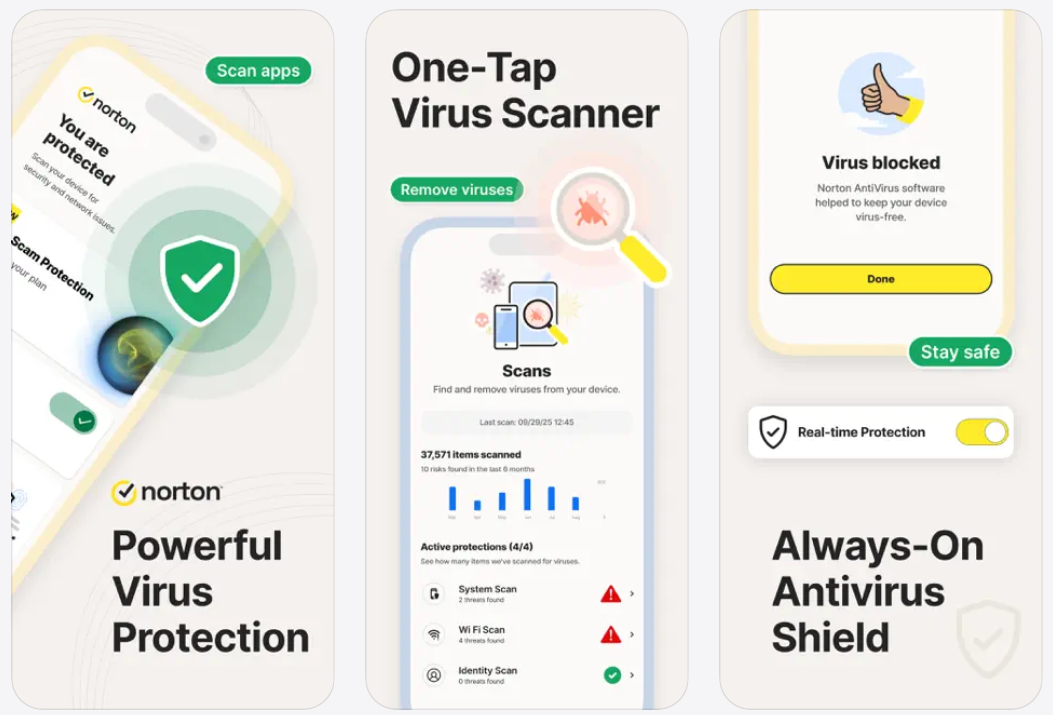
    VRS :-Navigate the web more safely with Norton 360 for iOS.

    Norton 360 ensures robust mobile security, including Al-powered malware protection, and VPN for privacy online. Built-in scam protection helps keep you safe while browsing, shopping, or texting.

    New: Scam Protection Pro

    Al-powered protection against sophisticated scams. Provides holistic coverage across email, web, phone calls, and SMS.

    Norton Genie – Al assistant

    Safe SMS: Al scam protection against spam calls

    Safe Web: Al helps protect you from scams when browsing online.

    Safe Call: Proactively blocks scam and junk calls

    Safe Email: 24/7 Al scam protection for your email inbox

    Device Security: scans for outdated operating systems and missing device passcodes to help you keep your data safer if your device is stolen.

    Norton Genie: Can answer your cyber safety questions, helps you identify scams in messages and in YouTube videos. [3]

    VPN: Help protect your private information with bank-grade encryption for a more secure connection, access to the content you love – wherever you are

    WiFi Security: scan WiFi networks to learn if your device is connected to vulnerable network.

    Safe SMS: filters spam SMS text messages that may contain phishing attacks with Al protection.

    Safe Web: advanced Al helps protect you from scams when browsing online by checking for scams on the pages you visit.

    Ad Tracker Blocker: Helps block ads on different platforms for added privacy & security.

    Dark Web Monitoring: We monitor the dark web and notify you if we find your personal information, security or privacy breaches.[2]

    Subscription details

    Feature availability may vary based on your plan and country.

    An annual subscription is required to activate the 7-day trial (see in-app product pricing).

    Cancel the subscription from your account before the end of the trial to avoid payment.

    After the 7-day trial, your subscription will start and automatically renew annually unless canceled.

    You can manage your subscriptions and adjust automatic renewals in your Apple account settings after purchase.

    The 7-day trial applies to eligible subscription plans and may vary by offer.
  • Phone Tracker

    Phone Tracker

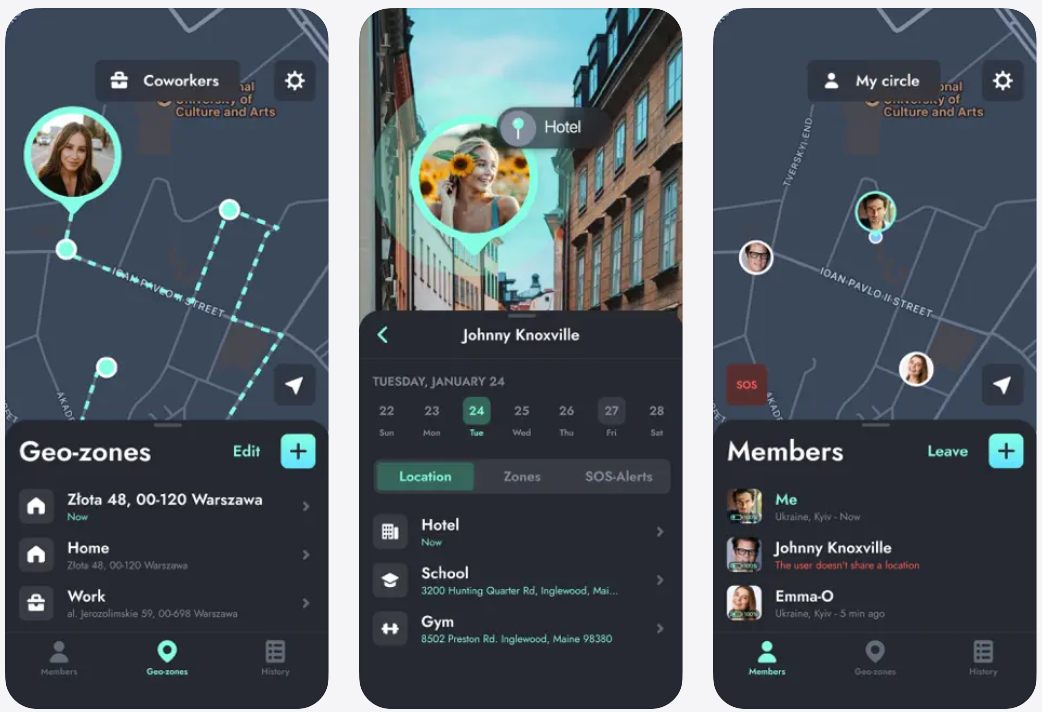
    GPS :-Phone Tracker – Family Locator is an application that uses GPS technology to help you locate and keep track of your family members, friends, and loved ones in real-time on a live, private map. With Circles, you can create a group of people who share their locations within the group, so you can easily track their location history and current location. Invite members by sharing a unique, private 6-digit number, and once they accept the invitation, you can locate them on the map at any time.

    The app also includes geofence zones, which allow you to know when any of your circle members enter or leave a certain area by creating a location-based boundary. You can drop a pin on the map to set the center of the geofence at a specific location, name your geolocation, set the radius for it, and get push notifications when someone enters or exits it. This feature can help you ensure that your loved ones are safe by automatically letting you know their whereabouts, without any effort from them.

    In case of emergencies, the app includes an SOS function that sends an urgent push notification to all members of your circle when you tap on the SOS button, along with a live update of your location. This feature ensures that your child, partner, or friend can alert you any time they need help or are in danger.

    Other features of the app include the ability to view the location history of each circle member, find a lost device using the GPS phone tracker, and manage group circles and geofence zones.

    Phone Tracker is your reliable GPS-based family locator and personal tracking app, designed to help keep your loved ones safe. It is not intended for spying or secret surveillance, and it cannot be installed remotely or without consent.

    To use the service, the user must install the app manually and approve the location-sharing request. By subscribing you can enjoy unlimited alerts, real-time tracking, extended location history and many more features!

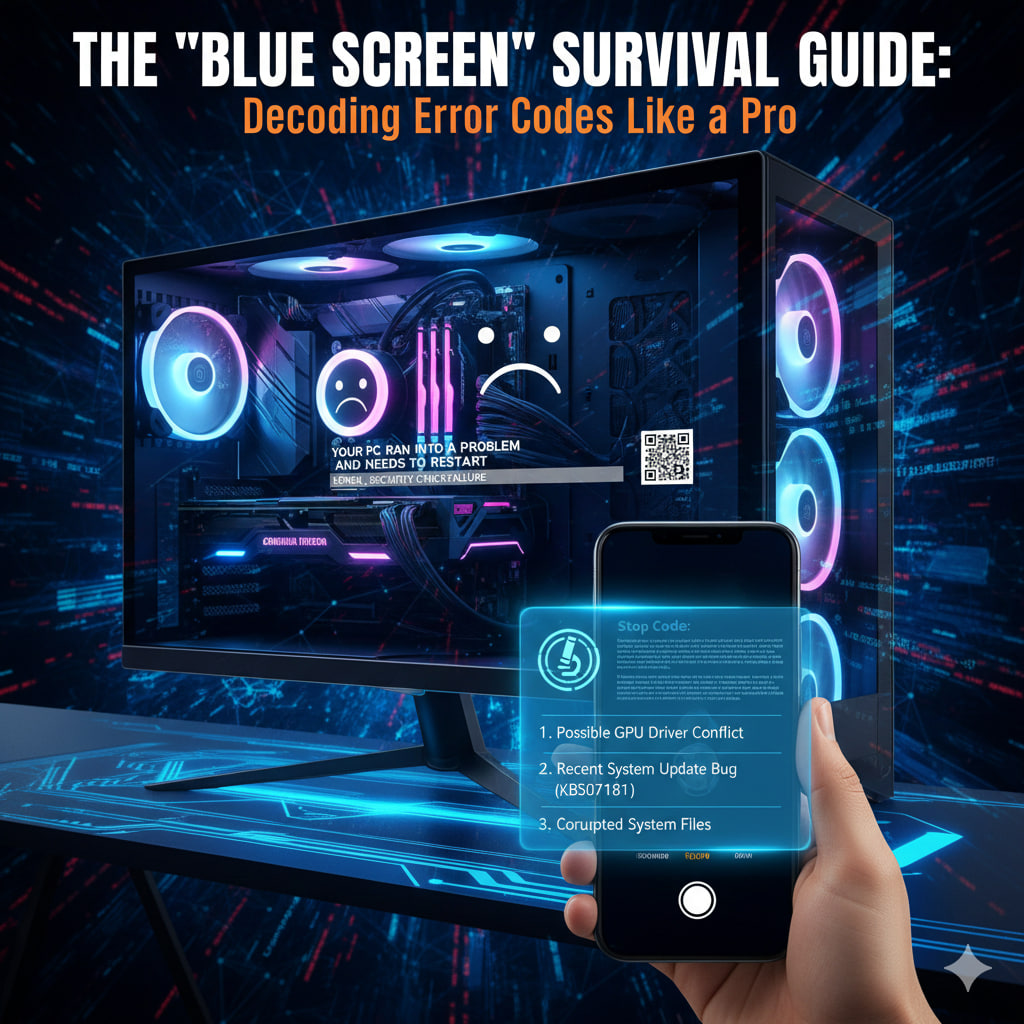
  • The “Blue Screen” Survival Guide: Decoding Error Codes Like a Pro.

    The “Blue Screen” Survival Guide: Decoding Error Codes Like a Pro.

    The “Blue Screen of Death” (BSOD) is arguably the most feared sight in computing. But in 2026, it’s rarely a “death” sentence; it’s actually a protective measure. Windows triggers a BSOD to freeze your system before a critical error can corrupt your data or fry your hardware.

    Think of it as a smoke alarm for your PC. To fix it, you just need to read the label on the alarm. Here is how to decode the most common 2026 error codes and get back to work.


    🔍 The “Big Five” Error Codes

    When the blue screen appears, ignore the sad face and look for the Stop Code (usually in ALL_CAPS at the bottom).

    Stop CodeWhat’s Actually HappeningThe Professional Fix
    CRITICAL_PROCESS_DIEDA vital part of Windows just “quit” the job.Run SFC /scannow in Command Prompt to repair system files.
    MEMORY_MANAGEMENTYour RAM is confused or physically failing.Run the Windows Memory Diagnostic tool (mdsched.exe).
    IRQL_NOT_LESS_OR_EQUALA driver tried to access memory it wasn’t allowed to.Roll back or update your most recent Network or GPU driver.
    INACCESSIBLE_BOOT_DEVICEWindows can’t find your hard drive anymore.Check your SSD cable or reset BIOS/UEFI to default settings.
    KERNEL_SECURITY_CHECK_FAILUREThe “brain” of the PC detected data corruption.Common in Feb 2026 due to GPU bugs; Update Windows to KB5077181.

    🛠️ The 3-Step Triage Process

    If you are seeing blue screens frequently, follow this professional diagnostic path:

    1. The “Ghost in the Machine” (Hardware)

    Unplug everything except your mouse and keyboard. If the BSOD stops, one of your peripherals (webcam, external drive, or even a USB hub) has a faulty driver or a short circuit. Re-plug them one by one until the “ghost” returns.

    2. The “Safe Haven” (Safe Mode)

    If your PC crashes before you can even log in, force it into Safe Mode.

    • How: Power on, then hold the power button to force a shutdown as soon as the Windows logo appears. Repeat this 3 times. On the 4th attempt, Windows will enter the Recovery Environment.
    • Why: Safe Mode loads only the bare essentials. If the blue screen doesn’t happen here, the problem is a software app or a 3rd-party driver you installed recently.

    3. The “Digital Surgeon” (SFC & DISM)

    If Windows feels “unstable,” use the built-in repair tools. Open Command Prompt as Administrator and run:

    1. sfc /scannow (Checks for basic file errors).
    2. DISM /Online /Cleanup-Image /RestoreHealth (Downloads fresh system files from Microsoft to replace broken ones).

    🚨 2026 Special Alert: The “Update” Bug

    As of February 2026, some users are reporting BSODs specifically after installing cumulative update KB5077181.

    • The Symptom: Random “System Hangs” or “Audio Glitches” followed by a crash.
    • The Fix: If your issues started this week, go to Settings > Windows Update > Update History > Uninstall Updates and remove the most recent February patch until a hotfix is released.

    Pro Tip: Take a photo of the BSOD with your phone. Many screens in 2026 include a QR Code that takes you directly to a Microsoft support page specific to your exact error.

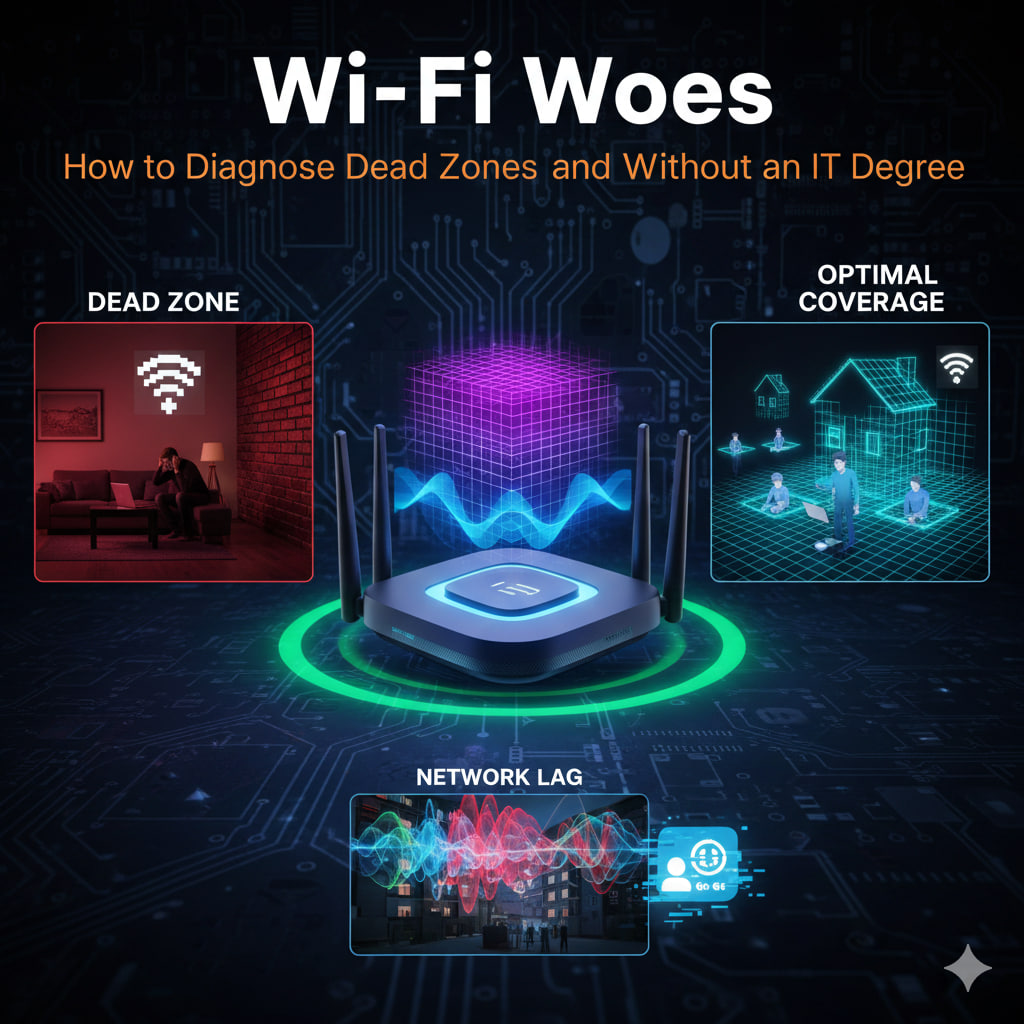
  • Wi-Fi Woes: How to Diagnose Dead Zones and Network Lag Without an IT Degree.

    Wi-Fi Woes: How to Diagnose Dead Zones and Network Lag Without an IT Degree.

    In 2026, a stable internet connection is as vital as electricity. Yet, many of us still treat our Wi-Fi routers like magical boxes—tucked away in cabinets or hidden behind couches—and then wonder why our Zoom calls freeze.

    You don’t need a degree in network engineering to fix this. You just need to understand the three pillars of wireless performance: Obstacles, Interference, and Hardware.


    1. Map Your “Radio Shadows”

    Wi-Fi signals are high-frequency radio waves. Like light, they struggle to pass through solid objects.

    • The Culprits: Brick walls, mirrors (which reflect signals), and large appliances (like refrigerators) act as “shadow-makers,” creating dead zones behind them.
    • The DIY Audit: Walk through your home with your phone. Look at the Wi-Fi “bars” or use a free Wi-Fi Analyzer app. Note where the signal drops from 4 bars to 2. That is your shadow line.
    • The Fix: Move your router to a central, elevated location. Every foot of height helps the signal “clear” the furniture that would otherwise absorb it.

    2. The 2.4GHz vs. 5GHz (and 6GHz) Dilemma

    In 2026, most routers are “Tri-Band.” Each band has a different job:

    • 2.4 GHz: Long range, but slow. This band is crowded by microwaves, baby monitors, and old Bluetooth devices.+1
    • 5 GHz / 6 GHz: Extremely fast, but short range. These bands can’t penetrate walls well.
    • The Red Flag: If your laptop is in the same room as the router but is stuck on the 2.4 GHz band, it will feel sluggish.
    • The Fix: Go into your router settings and ensure “Band Steering” is enabled. This automatically pushes your high-performance devices (laptops, TVs) onto the faster 5/6 GHz lanes while leaving smart bulbs on the 2.4 GHz lane.

    3. Diagnose the “Neighbor Noise” (Interference)

    If you live in an apartment or a dense neighborhood, your neighbor’s Wi-Fi is likely screaming over yours.

    • The Concept: Think of it like a crowded restaurant. If everyone is talking on the same “channel,” no one can be heard.
    • The Audit: Use a Wi-Fi scanner to see which channels are most crowded.
    • The Fix: Most modern routers have an “Auto-Optimize” or “Channel Scan” button in their app. This forces the router to “listen” for a quiet frequency and move your network there.

    4. When to Stop Troubleshooting and Upgrade

    Sometimes, the hardware simply isn’t up to the task.

    • The “One-Router” Limit: If your home is larger than 1,500 square feet, a single router will struggle.
    • The Solution: Switch to a Mesh System (like Eero, Nest, or ASUS ZenWiFi). Unlike “extenders” (which just repeat a weak signal), Mesh nodes work together to create a single, seamless blanket of coverage across the entire house.

    Wi-Fi Troubleshooting Cheat Sheet

    SymptomLikely CauseFirst Step
    “Dead Zone” in one roomPhysical ObstructionMove router or add a Mesh node.
    Full bars, but slow speedNetwork CongestionRestart router to clear the cache.
    Connection drops randomlyInterferenceChange the “Channel” in settings.
    Slow only in the eveningsISP Throttling/CongestionRun a wired speed test to confirm.

    Pro Tip: If your router has antennas, don’t point them both straight up. Aim one vertically and one horizontally. This helps the signal reach devices regardless of how their internal antennas are oriented.

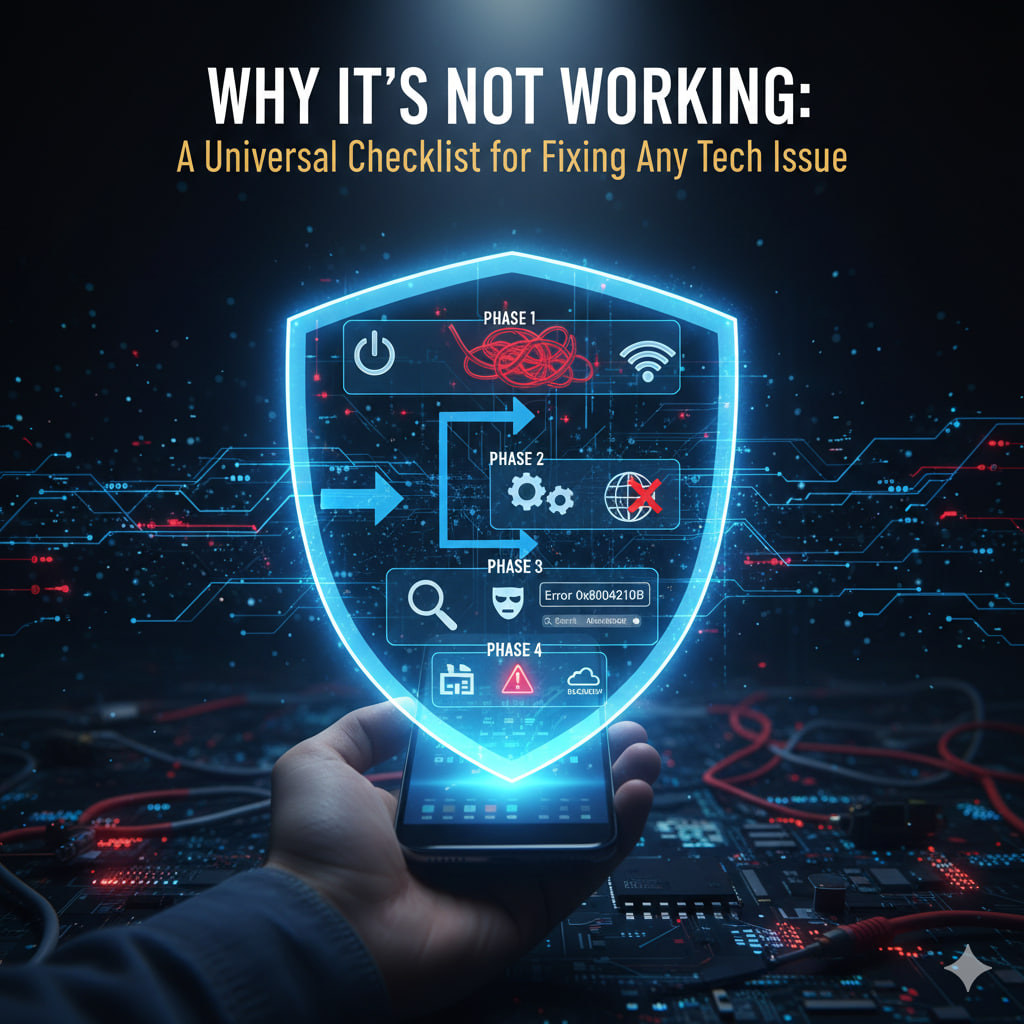
  • Why It’s Not Working: A Universal Checklist for Fixing Any Tech Issue.

    Why It’s Not Working: A Universal Checklist for Fixing Any Tech Issue.

    By 2026, technology has become more “integrated,” but that also means when one thing breaks, it often triggers a domino effect. Whether it’s a smart home hub, a VR headset, or a simple laptop, most tech issues stem from a handful of common failure points.

    Before you call tech support or give up in frustration, use this Universal Checklist. It is designed to move from the simplest (and most likely) fixes to more complex diagnostics.


    Phase 1: The “Lucky Break” Fixes (0–2 Minutes)

    Statistically, 90% of tech problems are solved in this phase.

    • The “Power Cycle” (Reboot): It’s a cliché for a reason. Restarting clears the RAM and kills “zombie” processes that are stuck in a loop.
    • The Physical Audit: Check every cable and connection. In 2026, wireless interference is also a “physical” issue—is your device too far from the router, or is a large metal object/appliance blocking the signal?
    • Check the Power Source: Is it actually charging? A loose USB-C cable or a dead power strip is often the “invisible” culprit.

    Phase 2: The Environment Check (2–5 Minutes)

    If the hardware is on but the software is failing, check the external factors.

    • The Update Check: We are in an era of “Continuous Deployment.” If your app version is even 24 hours out of date, it may be incompatible with the server. Check for OS and App updates immediately.
    • The “Is It Just Me?” Test: Use a site like DownDetector. If the service’s servers are down, no amount of troubleshooting on your end will fix it.
    • Connectivity Toggle: Turn Airplane Mode ON for 10 seconds, then OFF. This forces the device to re-handshake with Wi-Fi and Cellular towers.

    Phase 3: Isolation & Diagnostics (5–15 Minutes)

    This is where you play “Digital Detective” to find the root cause.

    • The “Divide and Conquer” Rule: If a website isn’t loading, try a different browser. If a peripheral isn’t working, try a different port. This tells you if the problem is the Source (the device) or the Path (the cable/app).
    • Safe Mode: Booting in “Safe Mode” (or “Incognito” for browsers) disables third-party extensions and custom settings. If the problem disappears here, a recently installed app or extension is the villain.
    • Read the Error Code: Don’t ignore the gibberish like Error 0x8004210B. Search for that specific code + your device model. In 2026, AI search engines can give you a plain-English solution for these codes in seconds.

    Phase 4: The “Nuclear” Options

    When all else fails, you must revert to a known working state.

    • Reset Network Settings: This wipes your saved Wi-Fi passwords and Bluetooth pairings, but it fixes almost all deep-seated connectivity bugs.
    • System Restore: If your device worked yesterday but doesn’t today, use a “Restore Point” to roll back the clock.
    • The Factory Reset: The final resort. This wipes the device clean. Warning: Always ensure your Cloud Backup (Phase 3 of our “Maintenance” category) is 100% complete before doing this.

    The Troubleshooter’s Quick-Reference

    If the Symptom is…Start Here:
    Device is “Frozen”Force Restart (Hold Power + Volume/Home)
    App Keeps CrashingClear Cache & Check for Updates
    Internet is SlowRestart Router & Move Closer
    Battery Draining FastCheck “Battery Usage” for Background Hogs
    Strange NoisesCheck for Dust/Blocked Vents (Overheating)

    Pro Tip: If you have to call support, tell them exactly which steps of this checklist you’ve already completed. It saves you 20 minutes of being asked “Did you try turning it off and on again?”

  • Spring Cleaning for Pixels: A Step-by-Step Guide to Organizing Your Cloud Storage.

    Spring Cleaning for Pixels: A Step-by-Step Guide to Organizing Your Cloud Storage.

    By 2026, the “infinite” storage we were promised a decade ago has become a costly subscription trap. Most of us are paying for “storage tiers” we don’t actually need, simply because our digital lives are cluttered with duplicate photos, 4K video clips we’ll never watch, and forgotten PDF downloads.

    Organizing your cloud isn’t just about aesthetics; it’s about reclaiming your monthly budget. Here is your step-by-step guide to a leaner, faster digital vault.


    Step 1: The “Heavy Lifter” Audit

    Storage is usually eaten by a small number of very large files.

    • The Action: Sort your cloud drive (Google Drive, OneDrive, iCloud) by “File Size” rather than date.
    • The Target: Look for screen recordings, unedited video projects, or ISO disk images. In 2026, AI-generated video files are the new storage hogs—if you’ve been experimenting with video generation, these “test” clips are likely sitting in your trash or “Downloads” folder, still counting against your quota.

    Step 2: Kill the “Burst” and the “Blur”

    Our photo libraries are often 30% “accidental” content.

    • The Action: Use your phone’s built-in “Duplicates” folder (iOS/Android).
    • The Target: Delete bursts where you only need one shot, blurry photos, and screenshots of things you’ve already bought or addressed.
    • The 2026 Tech: Use your OS’s “AI Cleanup” feature. Modern gallery apps can now group “Similar Images” and suggest the best one to keep, allowing you to delete hundreds of near-identical photos in a single tap.

    Step 3: The “Archive vs. Active” Philosophy

    Stop treating your Cloud Drive like a junk drawer.

    • The Action: Create a folder named “Archive [Year]”.
    • The Target: Move any project, tax document, or folder you haven’t touched in 6 months into this folder.
    • The Result: This keeps your “Active” view clean, reducing the cognitive load when you’re looking for something urgent. Once a year, you can move the entire Archive folder to an inexpensive physical SSD to free up cloud space entirely.

    Step 4: The “Zombie” Subscription Check

    Many of us pay for multiple cloud services without realizing it.

    • The Audit: Check your subscriptions for Google One, iCloud+, Microsoft 365, and Dropbox.
    • The Action: Consolidate. If you use Microsoft Word for work, you likely already have 1TB of OneDrive storage included. There is no reason to pay for a 2TB Google One plan as well. Pick one “home” for your data and migrate the rest.

    Cloud Efficiency Checklist

    TaskFrequencyStorage Reclaimed (Avg)
    Empty “Trash” & “Spam”Weekly500 MB
    Delete Large Video AttachmentsMonthly5 GB+
    Consolidate Duplicate PhotosQuarterly2 GB+
    Offload “Archive” to Physical DriveYearly50 GB+

    Pro Tip: In 2026, most cloud providers offer a “Storage Map” visualizer. Before you delete anything, look at the graph to see if your space is being taken by Mail, Photos, or Drive. Don’t waste time deleting tiny emails if your “Photos” are taking up 90% of the space.

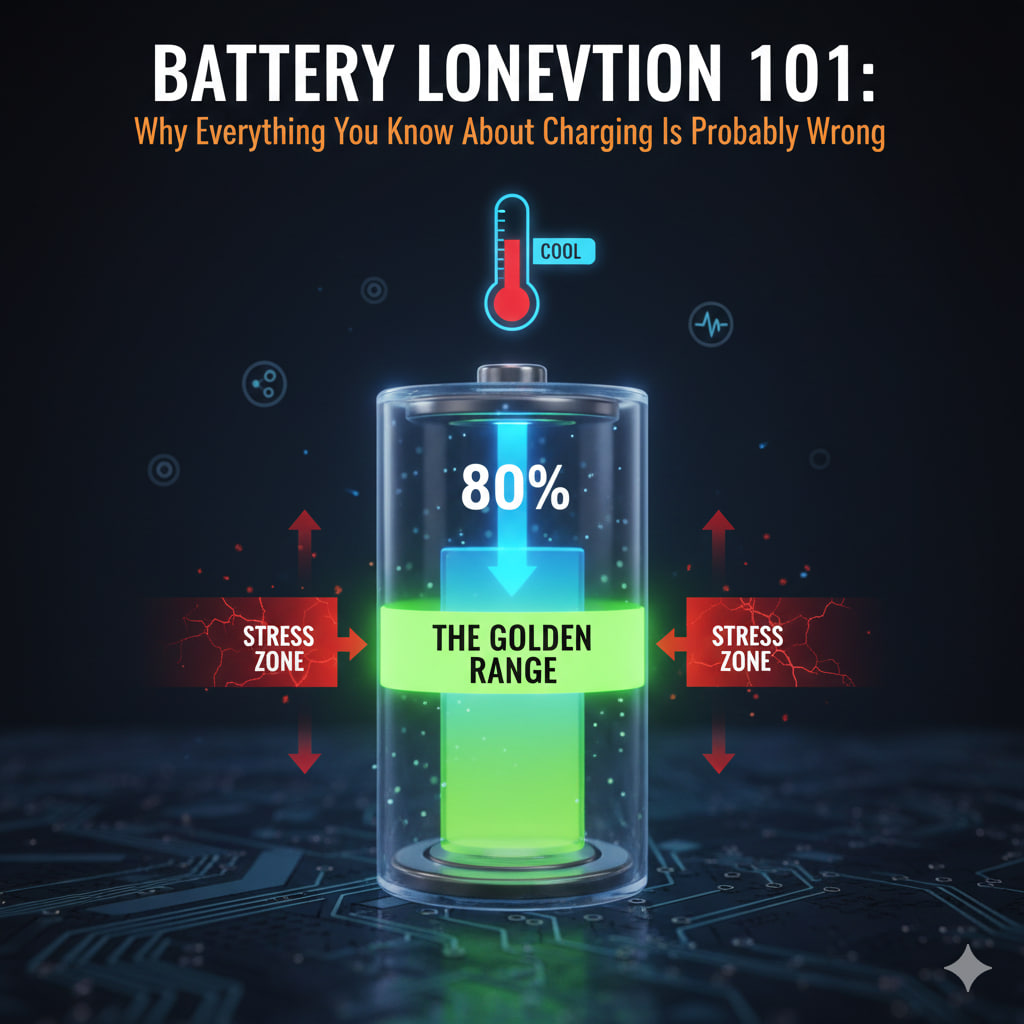
  • Battery Longevity 101: Why Everything You Know About Charging Is Probably Wrong.

    Battery Longevity 101: Why Everything You Know About Charging Is Probably Wrong.

    For years, we’ve been treated to a library of “battery myths” born from the era of old nickel-based batteries. But it’s 2026, and the Lithium-Ion (Li-ion) and Lithium-Polymer (Li-Po) cells in your smartphone, laptop, and EV operate on entirely different physics.

    If you’re still draining your phone to 0% or leaving it plugged in all night without the right settings, you are actively killing your device’s lifespan. Here is the modern science of battery health.


    1. The “Golden Range”: The 20-80 Rule

    The biggest misconception is that batteries like to be “full.” In reality, Lithium-ion batteries are under the most physical stress when they are at 100% or 0%. Think of it like a rubber band: it’s most comfortable when it’s relaxed in the middle, not stretched to its limit.

    • The Science: Charging to 100% increases the “voltage stress” on the battery chemistry.
    • The Fix: Try to keep your battery between 20% and 80%. In 2026, most OS settings (iOS, Android, Windows) have a “Limit Charge to 80%” toggle. Enable it. This can nearly double the number of charge cycles your battery can survive.

    2. Heat is the “Silent Killer”

    Fast charging is convenient, but it generates immense heat. Heat causes the internal structure of the battery to degrade.+1

    • The Red Flag: Using your phone for gaming or high-intensity video editing while it’s on a fast charger.
    • The Fix: If your phone feels hot to the touch, unplug it. Avoid cheap, off-brand “super chargers” that don’t have proper thermal regulation. Slow charging overnight is actually better for longevity than blasting it with 100W of power.+1

    3. The “Full Cycle” Myth

    You do not need to “calibrate” modern batteries by draining them to 0%. In fact, deep discharges are the fastest way to cause permanent capacity loss.

    • The Science: Modern batteries count a “cycle” as a total of 100% discharge, regardless of how many sessions it takes. (Charging from 50% to 100% twice equals one cycle).
    • The Fix: Charge in “snacks,” not “meals.” Frequent, short top-ups are much better for the chemistry than one long, heat-inducing charge from empty to full.

    4. Storage Secrets

    If you’re going to leave a laptop or an old phone in a drawer for a few months, don’t leave it at 100% or 0%.

    • The Fix: Power it down at roughly 50%. A battery stored at 0% can fall into a “deep discharge state” where it may never hold a charge again.

    Battery Health Checkup (Where to find it)

    DevicePath to SettingsFeature to Enable
    iPhoneSettings > Battery > Battery HealthOptimized Battery Charging
    AndroidSettings > Battery > Battery ProtectLimit to 80%
    MacBookSystem Settings > BatteryOptimized Charging
    WindowsSurface/Laptop App (Manufacturer specific)Smart Charging / Battery Limit

    The Bottom Line

    In 2026, a well-treated battery should last 4–6 years before noticing significant degradation. A mistreated one will begin to fail in 18 months. By avoiding the “extremes” (0% and 100%) and keeping it cool, you’re saving yourself hundreds of dollars in replacement costs.

    Key Takeaway: 80% is the new 100%.


  • The Silent Slowdown: How to Manage Startup Apps and Reclaim Your RAM.

    The Silent Slowdown: How to Manage Startup Apps and Reclaim Your RAM.

    In 2026, even the most powerful machines can feel sluggish. The culprit isn’t usually a virus; it’s “Software Bloat”—a collection of apps that grant themselves permission to start the moment you log in. These “silent” background processes eat into your RAM (Random Access Memory), leaving less room for the apps you are actually trying to use.

    Reclaiming your RAM is the single most effective “free” upgrade you can give your computer. Here is how to do it in 2026.


    1. The 2026 “Startup Audit”

    Not every app needs to be ready at a moment’s notice. You need to distinguish between Core Utilities and Resource Hogs.

    • Keep Enabled: Security software (Antivirus), Cloud Sync (if you save files constantly), and hardware drivers (audio/mouse software).
    • Disable: Game launchers (Steam, Epic), Communication apps (Teams, Discord, Slack), and “Update Helpers” for software you rarely use.

    2. How to Reclaim Control (Windows & Mac)

    The methods have evolved to be more user-friendly, but the “Pro” tools remain the most effective.

    For Windows 11/12 Users:

    • The Quick Way: Press Ctrl + Shift + Esc to open Task Manager. Navigate to the Startup Apps tab. Look at the “Startup Impact” column—anything labeled “High” is your primary target. Right-click and select Disable.
    • The Deep Clean: Open Settings > Apps > Startup. This menu provides a cleaner interface and toggle switches to manage background behavior.
    • The Secret RAM Eater: Disable SysMain (formerly Superfetch). This service preloads apps into RAM that you might never use. Search for “Services,” find SysMain, right-click, select Properties, and set “Startup type” to Disabled.

    For macOS Users:

    • The Standard Way: Go to System Settings > General > Login Items. Under “Open at Login,” select an app and click the minus (-) button to remove it.
    • The “Background” Audit: Below the login items, look at “Allow in the Background.” This is where apps like Adobe or Google Chrome hide “updaters” that run even if the app is closed. Toggle off anything non-essential.
    • The Force Purge: If your Mac feels stuck, open Terminal and type sudo purge. This flushes the inactive memory and forces the OS to reallocate RAM to your active windows.

    3. The “Ghost Process” Cleanup

    Some apps don’t appear in the standard startup lists.

    • Browser Extensions: Each Chrome or Edge extension is its own background process. Go to chrome://extensions and remove anything you haven’t used in a month.
    • The “Zombie” Tab: In 2026, most browsers have “Memory Saver” mode. Ensure this is ON to “freeze” tabs you aren’t looking at, instantly freeing up gigabytes of RAM.

    Performance Impact Cheat Sheet

    ActionRAM Reclaimed (Est.)Impact on Speed
    Disable High-Impact Startup Apps500MB – 1.5GB⚡⚡⚡ (Faster Boot)
    Enable Browser Memory Saver1GB – 3GB⚡⚡⚡ (Less Lag)
    Disable SysMain / Background Tasks200MB – 600MB⚡ (Steady Performance)
    Clear Clipboard & Temp Files100MB – 300MB⚡ (System Stability)

    Pro Tip: Aim to keep at least 20% of your RAM free at all times. When RAM usage hits 90%+, your computer begins using your much slower hard drive as “Virtual Memory,” which is the primary cause of system freezes.

  • The Phishing Evolution: Modern Red Flags Every Internet User Should Know.

    The Phishing Evolution: Modern Red Flags Every Internet User Should Know.

    In 2026, the era of the “obvious” scam—the one filled with broken English and suspicious logos—is largely over. Thanks to Large Language Models (LLMs) and Generative AI, phishers can now create “perfect” lures that mimic your boss, your bank, or even your family with terrifying accuracy.

    To stay safe, you need to look beyond the surface. Here are the modern red flags of the “Phishing 2.0” era.


    1. The “Perfect” Voice (AI Cloning)

    Scammers now use as little as 3 seconds of audio from your social media to clone a loved one’s voice. They then call you claiming a “family emergency” or a “legal crisis.”+1

    • The Red Flag: The voice sounds exactly like someone you know, but the emotional cadence is flat, or there are tiny digital artifacts (like subtle robotic echoes or odd pauses).
    • The Defense: Establish a “Family Safe Word” that can’t be found on social media. If they can’t provide the word, hang up.

    2. “Quishing” (QR Code Phishing)

    In 2026, attackers have moved off the screen and into the physical world using malicious QR codes. You might find these on parking meters, restaurant menus, or “urgent” physical mail.

    • The Red Flag: A QR code on a sticker that looks like it was pasted over an original code, or a code that directs you to a website asking for your login credentials immediately.
    • The Defense: Inspect the physical code for tampering. Never use a QR code to “verify” an account; type the official website address into your browser instead.

    3. Hyper-Personalized Spear Phishing

    Old phishing was “spray and pray.” Modern phishing is a “sniper shot.” AI now scrapes your LinkedIn, recent news, and corporate filings to write an email that mentions your specific current projects.

    • The Red Flag: An email from a “colleague” or “CFO” that feels unusually well-informed about your week but asks you to bypass a standard security procedure (like a wire transfer or a password reset).
    • The Defense: Always use an “Out-of-Band” verification. If your boss emails you a strange request, call or text them on their personal number to confirm.

    4. Deepfake Video Calls

    It happened in 2024, and by 2026 it has become a “Scam-as-a-Service.” You might join a Zoom or Teams meeting where multiple “executives” appear on screen, but they are all deepfakes.

    • The Red Flag: Look for visual jitter around the edges of the face, mismatched lip-syncing during rapid speech, or a person who never blinks or turns their head to the side (where AI often “breaks”).
    • The Defense: Ask the person to do something unexpected, like “Turn your head to the left” or “Wave your hand in front of your face.” Most AI models in 2026 still struggle to render these movements in real-time.

    Quick Comparison: Old vs. New Phishing

    FeatureTraditional PhishingModern AI Phishing (2026)
    GrammarPoor, many typos.Flawless, professional tone.
    UrgencyGeneric (“Your account is locked”).Specific (“Your Q3 budget is overdue”).
    MediumMostly Email/SMS.Voice, Video, QR, and AI Chatbots.
    GoalMass credential harvesting.Targeted financial or data theft.

    Pro Tip: In the AI age, skepticism is your strongest firewall. If a digital interaction triggers a “gut feeling” that something is off, it probably is.

  • Digital Invisible Man: How to Audit Your Smartphone’s Privacy Settings in 5 Minutes.

    Digital Invisible Man: How to Audit Your Smartphone’s Privacy Settings in 5 Minutes.

    In 2026, our smartphones aren’t just communication devices; they are high-precision sensors that track our movements, habits, and even the people we stand next to. While manufacturers have added powerful privacy tools, they are often buried under layers of menus.

    Becoming a “Digital Invisible Man” isn’t about disappearing from the grid—it’s about ensuring your phone only shares what you’ve explicitly allowed. Here is your 5-minute privacy audit for 2026.


    Minute 1: The “Who’s Watching?” Check (Permissions)

    The biggest threat to your privacy isn’t a hacker; it’s the weather app that’s tracking your location 24/7.

    • The Audit: Go to Settings > Privacy & Security > Permission Manager (Android) or Privacy & Security (iOS).
    • The Hit List: Focus on Location, Camera, and Microphone.
    • The Action: Set non-essential apps to “Ask Every Time” or “While Using the App.” In 2026, look for the “Approximate Location” toggle—use this for apps like Weather or News so they know your city, but not your street address.

    Minute 2: Silence the “Shoulder Surfers” (Lock Screen)

    In 2026, AI-driven “Shoulder-Surfing” prevention is standard on flagship phones (like the S26 or iPhone 17), but you have to turn it on.

    • The Audit: Go to Settings > Notifications > Lock Screen.
    • The Action: Enable “Sensitive Content Masking.” This hides the text of your messages until the phone recognizes your face via Biometrics.
    • The 2026 Tech: If you have a high-end device, enable “Intelligent Masking” or “Privacy Display.” These use the front camera to detect if someone else is looking at your screen and automatically blurs the content.

    Minute 3: Kill the Data Trail (Activity Controls)

    Google and Apple keep “logs” of your activity to improve AI recommendations, but this is essentially a digital footprint of your life.

    • The Audit: * Android: Settings > Google > Manage Account > Data & Privacy.
      • iOS: Settings > Privacy & Security > Tracking.
    • The Action: Toggle “Allow Apps to Request to Track” to OFF. On Android, set your “Web & App Activity” to Auto-Delete every 3 months. This forces the “Ghost” to clean up after itself.

    Minute 4: The Hardware Kill-Switch (VIP/Lockdown Mode)

    Sometimes you need a “Digital Bunker” for sensitive meetings or travel.

    • The Audit: Search your settings for “Lockdown Mode” (iOS) or “Sensors Off” (Android Developer Options).
    • The Action: Learn the shortcut to activate these. In 2026, many phones feature a “VIP Mode” that logically cuts power to the microphone and camera. Use this when you want 100% certainty that no background app is “listening in.”

    Minute 5: The “Find My” Checkup

    If your phone is stolen, the thief’s first move is to turn off the data.

    • The Audit: Go to Settings > [Your Name] > Find My.
    • The Action: Ensure “Find My Network” and “Send Last Location” are enabled. In 2026, this allows your phone to be tracked even if it’s powered off or has no SIM card, using a mesh network of other nearby devices.

    The 2026 Privacy Shield Checklist

    FeatureRecommended SettingBenefit
    App TrackingDisabledPrevents apps from following you across the web.
    Location“While Using”Stops background tracking and saves battery.
    Clipboard AccessNotifyAlerts you if an app reads what you just copied.
    AI ProcessingOn-Device OnlyKeeps your data out of the provider’s cloud.

    Pro Tip: Set a recurring calendar invite for every 3 months labeled “Digital Oil Change” to run this 5-minute audit again.